Metronome
A steady click you can reach on its own or find already dialed to a song's tempo — how to set the beat, shape its feel, and decide how it behaves around other audio.
Timing is what separates a bassline that locks with the drummer from one that fights him. The metronome gives you something steady to lock onto while you close that gap — a click you can shape to match whatever you're working on, from a walking line that keeps rushing to a groove you're trying to bring up to speed.
Where you'll find it
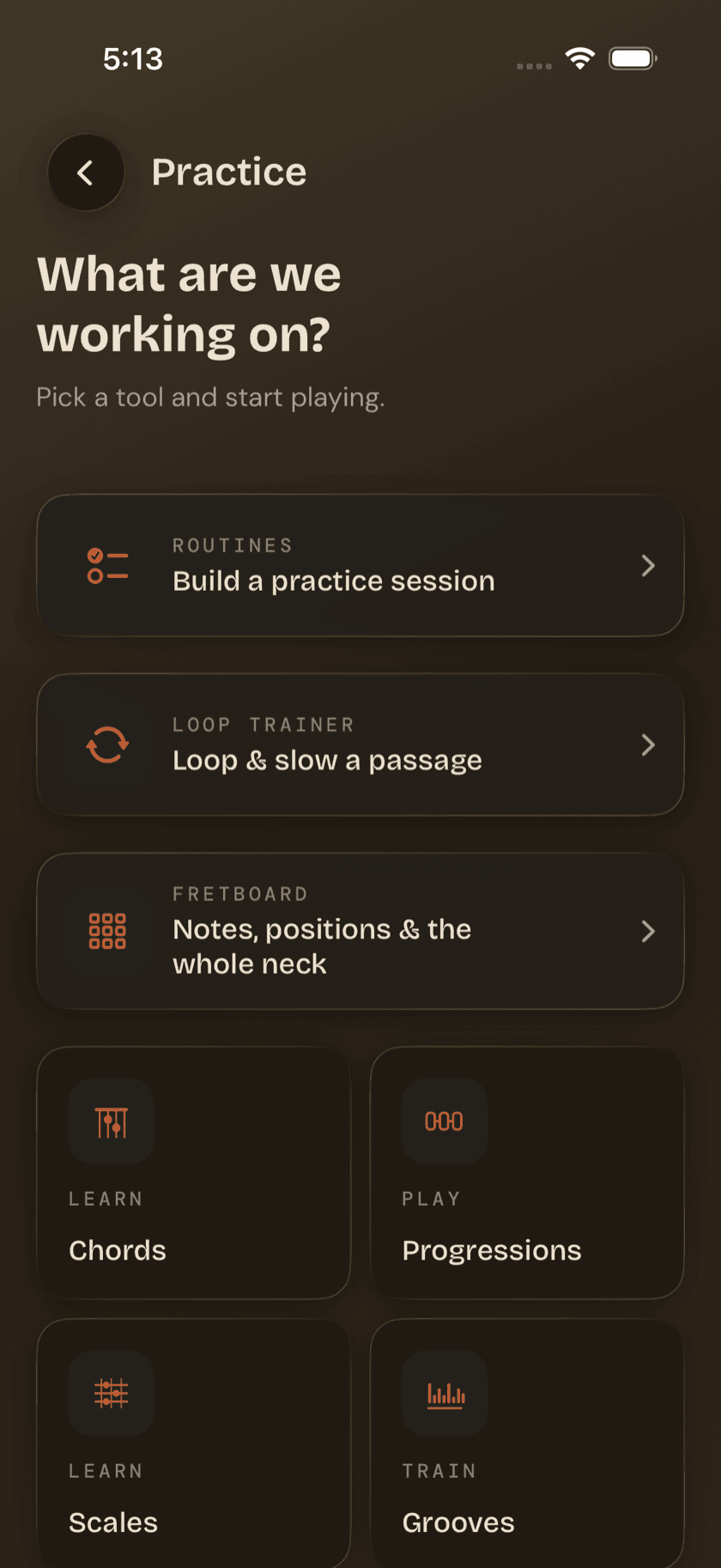
Open it on its own from the Metronome tile in the Practice Hub, or find it already built into a song's Practice this song session — pre-set to that song's own tempo, so you're not hunting for a number before you can start playing.
Setting the tempo
Tempo runs from 40 to 240 BPM. Drag the slider to get there fast, tap the +/- buttons to nudge it a beat at a time, or use tap-tempo — tap it out a few times in the rhythm you're after and it sets the number for you. Tap-tempo is the quickest route when you know how a groove should feel but not what number that feel is.
Time signature and subdivision
Choose from four time signatures — 3/4, 4/4, 6/8, 7/8 — and four click subdivisions: quarter notes, eighth notes, triplets, or sixteenth notes. A row of beat dots pulses along with the click, one dot lit per beat, so you can see the pattern as well as hear it — worth turning your eyes to once a busy sixteenth-note line starts to outrun what you can reliably count in your head.
Sound and accent
Pick a click tone — Wood, Click, Cowbell, or Mute — whichever cuts through your amp or headphones best. Turn on the accent toggle and beat 1 lands harder than the rest, so the downbeat stays obvious even on a line that spends most of a bar deliberately off it.
Mixing with other audio
One toggle decides how the click behaves around anything else playing. Leave it on ducking and the metronome takes over — it quiets whatever else is running and puts its own transport controls on your lock screen. Switch it to mixing and the click sits quietly underneath whatever else is playing instead, without taking over.
Worth knowing: ducking is built for practicing against the click alone — it's meant to be the only thing you hear, lock-screen controls included. Mixing is for practicing alongside something else already playing, like a Jam session or a backing track, where the click just needs to sit underneath it, not push it aside.
A calmer way to sit with your bass.
Learn songs, capture ideas, jam over backing tracks, and tune up — free, local-first, on iOS, iPadOS & macOS.
Explore Bass Buddha →